We've released a new album!

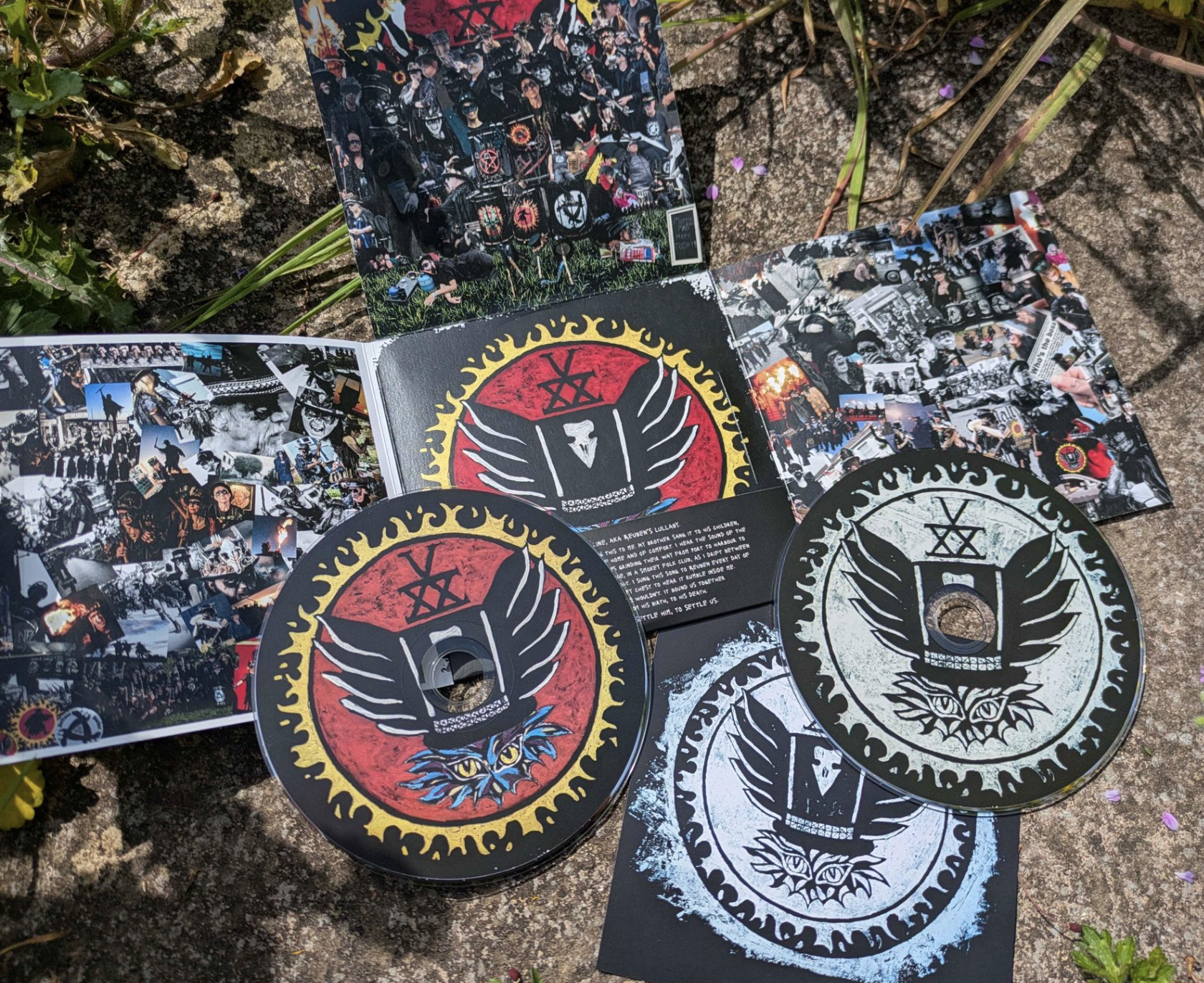
To celebrate our 25th birthday, we present XXV - our first-ever double album. You think you've heard our dances before, but not like this... Raw, loud, and unabashed, we're very proud of this.

Two, yes, two CDs worth of Beltane passion and grit. CD1 (B&W) is the band as you hear us out in the flesh, and CD2 (colour) is the private, behind-the-scenes Beltane, sharing our songs and dreams.

Launched on 1st May (but of course) you can bag a physical CD and a digital download for your collection from our Bandcamp page.


Beltane Border Morris in BBC's Beyond Paradise

Can’t even switch on your television without seeing a flock of ragged crows on speed, as we, quite rightly, were described by one punter not so long ago.

Every now and then, we like to surprise folk by doing something slightly bewildering and so we were quite excited to get involved in a bit of television skulduggery to help showcase dark Morris.

It began in the mists of time as these things often do. Or, more accurately, it started last year when we were approached by the nice television folk behind the cosy crime show Beyond Paradise — you know, the cosy crime series that leans into the myths and legends of Devon and Cornwall.

They told us they had a cosy crime storyline centring around a Dark Morris side, that they wanted to portray Beltane’s intense dark border style and would we be up for it?

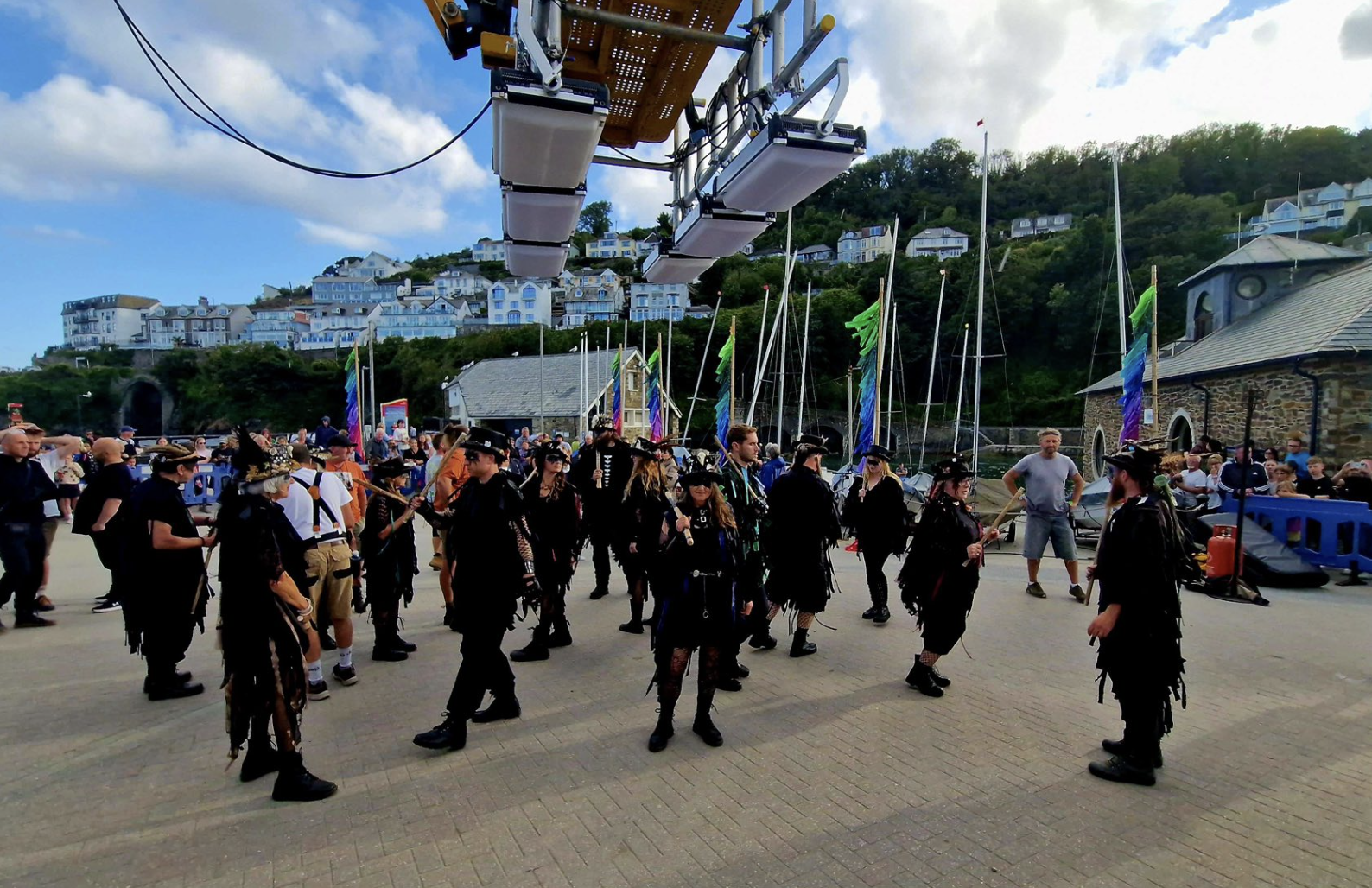
They were keen to use our Fire Dance in their sequence. Written by the team, the (in)famous Beltane dance closes our performances. It represents a great opportunity for people to stand inside the dance while corvids spin, serpentine-like, and clash sticks all around. Fire Dance’s finale culminates with an invitation to spectators to join a swirling, joyous mass of dark Morris-y folky dancing.

Ah, if you’ve experienced it, you’ll know. It’s like being in the centre of a roaring fire made of black thrashing flames. If you haven’t lived through this yet, then what are you waiting for? Come see us!

So, anyway. There we were, contemplating the ask. I mean, it’s not our usual skulduggery, is it? We talked. We umm’ed and ahh’ed. We talked about how it represented an opportunity to platform Morris and the community we love. We talked some more. Then agreed.

Our very own Nathascha Heijen and Squire Ant worked with Beyond Paradise’s producers to integrate the ethos of Morris into their script and how the choreography and music could bring the myth to life all while ensuring the end result — using an entirely fictional onscreen identity — could still retain the unique and authentic Beltane look, sound and feel.

And so last summer a small flock of dancers and musicians crossed the Tamar (btw, another one of our dances, Tamara, is inspired by the legend of this splendid river) to do our fierce Beltane thing. Actually, we did it because we love to perform and we love Morris.

We couldn’t talk about it for ages. We swore not to. We crossed our dark hearts.

Somehow or other we managed to keep schtum even after too many ales. Even our social media scallywags stayed schtum right up until the week the show aired on BBC One.

We won’t spoil it for you. Check out BBC iPlayer if you want to see whodunnit.

Interview with Liz Wozniak

How did you first get into Morris dancing?

I was working in a local primary school as a Teaching Assistant when a friend at the school, who was a morris dancer, suggested I go along to Exmoor Border Morris and have a go.  As I'd loved country dancing at school (they don't do that anymore) and thought morris might be a bit similar, I thought why not and I bowled along one evening. I never looked back. That was around 2000.

What is one of your favourite Morris highlights? 

That's a tricky one - there are so many lovely memories. I think I have to give 3 a mention.

Firstly, being Squire of Exmoor Border Morris when we celebrated our 10th Anniversary with a fantastic birthday bash based at The Hunter's Inn on Exmoor.  It was a fabulous weekend where I met and made friends with many dancers and musicians from, Powderkegs, Stone the Crows, Fox's Morris and Bunnies from Hell amongst others.  I'm still friends with lots of them today.

Secondly, the formation of my own border morris side, AngleTwitch, in 2013 and which we disbanded in 2022 after covid.  Oh, what fun we had.  Small but beautifully formed!!

And, thirdly, dancing with Beltane - especially at Shrewsbury and Sidmouth as an invited side.  Both of those were on my 'morris bucket list' so I can tick them off now.  

Besides Morris dancing, do you have any other folk talents?  

Well, you know when your fingers tap along to the music but you can't actually play an instrument... I decided to learn to play an accordion which is tricky when you start in your mid 50's.  I can play competently but I'm definitely not an impressario, and used to play in a lot of sessions and for dancing with Exmoor, AngleTwitch and Bourne Borderers a while back, but not so much now.  It's such a big, heavy old thing to lump around - not the sort of thing you can easily slip into your pocket.  I'm quite good on the Kazoo, though, which I do keep in my Beltane tatter inside pocket ready for a toot at the appropriate moment!

What first drew you to Beltane?

I knew about Beltane long before I joined them as I had seen them at festivals that I was dancing at myself.  I live on the north coast and Beltane are very much based south of the county so I couldn't consider joining them until I retired.  I loved everything about them - but guess I was most attracted to their accurate dancing.  Dancing 'for' fun is different to dancing and 'having' fun.  I have always put performance first in my mind - you can still have great fun, I would say 'more' fun and satisfaction, when giving a great performance than just 'dancing for fun' which is the strap line of too many dance sides in my view.  So that was what attracted them to me, plus the great amplified music which was somewhat unusual and a bit frowned upon back in the day. Beltane have always been edgy.

Which is your favourite Beltane dance to perform? 

That's got to be Shapeshifter.  Beautiful, poignant tune and one which probably evokes the greatest emotional response form both dancers and audience.  Having said that I also love dancing Cross Tree and am especially pleased that the 'serge' move was suggested by me. I haven't seen any other side perform that move.

What is the best thing about being in Beltane? 

Such difficult questions to answer in one sentence. I obviously like the fact that we write a lot of our own material as alluded to in the previous question.  The camaraderie, especially when we go on weekends away - they can be a lot of fun and the sheer variety of personalities, talents and different backgrounds that make up the side.  That's one of the beauties of any morris side, the fact that it's for anyone and everyone.

Do you have any favourite sides you look forward to watching during out season?

Well, my favourite sides have got to be those which give a great performance and bring their own style in both music, costume and accuracy.  I like all styles of morris if performed well.  Some of my favourites would be Earlsdon, Gog Magog and Pig Dyke.  I like The Witchmen - they have a nice, controlled style of border and unique musical sound.  And you've got to give it to them - Boss Morris have done Cotswold morris (and all morris, I suspect) a good turn by daring to think outside the box but still be disciplined in their dance performance, and for engaging so many non-morris onlookers and encouraging them to have a go.

Are there any particular gigs you are looking forward to this year? 

I like to go to pastures new which, this year, isn't going to happen for me but the line-up at Priddy looks great so I'm hoping we're not dancing during at least some of the gigs I'd like to see.  And if it's confirmed we're going to Bunkfest that would be great.  We've always had lovely weekends there and it's been a good few years, so looking forward to that.  

Like watching a flock of ragged crows on speed

We made quite the impression at our gig at The Anchor Inn, Cockwood with Isambard’s Gasket Rats.

Glowing review in the Mid Devon Advertiser from one of the punters trying to have a quiet pint

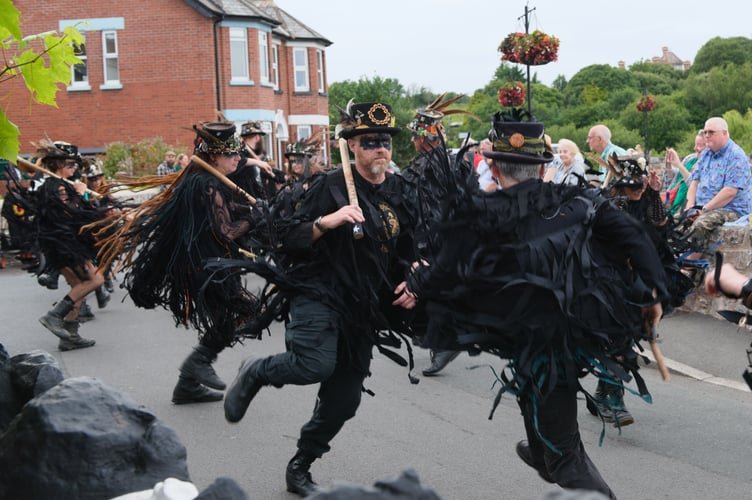
‘It was like watching a flock of ragged crows on speed,’ said one drinker. ‘None of the tinkly bells or hankies like traditional Morris dancers. But this was full on brilliant.’

Beloved Beltane Corvid Flies Free

We were all immensely sad to hear of our friend Dave’s passing before May Day. Dave’s ‘Beltane stare’ was the envy of all and he cared deeply about fellow Corvids and about Beltane itself. Within a year of him joining we had integrated his ‘marginal gains’ ethos to always make things better which strengthened our look, sound and overall personality. He quietly and selflessly helped those in need and will be remembered very fondly by everyone in the side.

Dave was certainly with us on Beltane morning, we felt him in the atmospheric lightning and powerful community vibes.

Fly free, Dave 🖤

Dartmoor Tors Festival line up announced

We’re excited to dance at the first ever Dartmoor Tors Festival this year, celebrating the beauty and power of our beloved Dartmoor.

We’ve got a mention in this article from West Country Voices, this one in the Mid Devon Advertiser, and this one from Herald Express.

Folk music legend Seth Lakeman will be headlining on the Saturday night; other speakers and performers include the international artist Garry Fabian Miller, novelist Fiona Williams, poet/artist Sean Borodale, storytellers Sara Hurley and Lisa Schneidau, and the ‘dark and wild’ Beltane Border Morris side.

Check out the event website for more information and stay tuned to our See Us Live page for times and locations!

Spot us in the Box’s latest exhibition

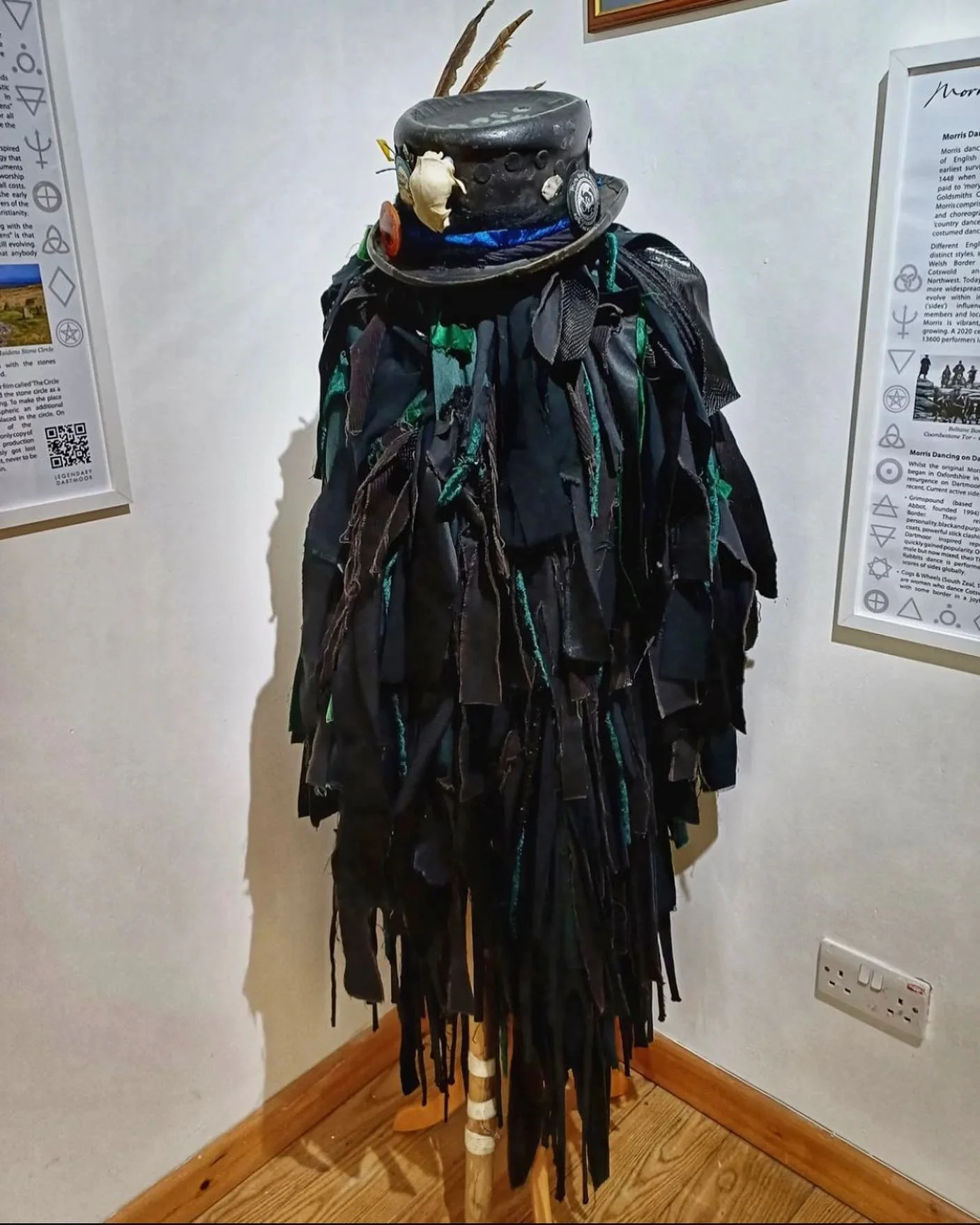
Can’t go anywhere without seeing one of our hats popping up - this time we are in The Box in Plymouth as part of their Carnivalesque in the Far South West exhibition. The exhibition explores links between street performance and political resistance as well as other related traditions in Plymouth, Devon and beyond in response to the John Lyons’ Carnivalesque, also on show there.

Photo courtesy of Ethan Pennell, who we happily share a space with - check out his epic Dartmoor Folklore Map!

Wassail Ritual - The Blessing of Fruit Trees

Our very own Nathascha Heijen compiled this article on wassailing in 2011, little did she know she would become so entwined with it through Beltane!

To your health!

In January, people in England gather in fruit orchards to bless the trees in a ritual called a 'Wassail'. This comes from 'waes hael' and means something like: 'to your health'. You could also easily see “wees heil” in it, which stems from Germanic languages and means “be whole”.

Wassailing is an echo of rituals from older times in which, after the last harvest in late autumn, a sacred drink was poured onto the fields to bless them for the coming spring and to ward off evil spirits. The deeper motivation is to be assured of a good yield for the next harvest year.

That is still the driving force in more modern times, but the timing of this blessing has been moved from late autumn to January. The Wassail ritual was usually held on the Twelfth Night. The most traditional preferred date is January 17th because this date is the “old 12th night” of Christmas (according to the pre-Gregorian calendar). On the Gregorian calendar it is January 5th or 6th

Awake, nature, awake!

Holding a Wassail in the orchard and on or near fields is the first fertility ritual of the new year and it usually takes place before Imbolc. The Wassail ritual was intended to inspire the saps to flow again in the trees and the land. An awakening of nature! At contemporary Wassailing, fruit trees are helped to come out of hibernation by waking them up with noise. The health blessing or health drink must ensure a good harvest!

The bee colonies play an important role in a good fruit harvest and therfore, in the oldest known Wassail rituals, the bees were also blessed. I propose that we indeed involve them again in our rituals. Bees are a very important link in our existence. And in these times where bees are at risk, a toast to their health wouldn’t do us any harm.

Wassail folklore

Wassailing mainly takes place in apple and pear cider producing regions in England, but in other countries too, the blessing of trees (and animals) can be found in their folklore. In Belgium and the Netherlands, horses are blessed, as well as fields and tools. And how about tractor blessings! Yes, these exist too.

A traditional Wassail ritual often consists of the following basic elements:

  • For the blessing, a bowl specifically dedicated to this task was used, often made of Sycamore wood because it has no flavor of its own. Later, a ceramic, earthenware or porcelain bowl was used. The bowl has a handle on each side similar to the Scottish friends cup called a “quaich”. The Wassail bowl would only be used for the purpose of the Wassail ritual.

  • Just before evening fell, the brew for the healing drink was prepared. This was often an alcoholic drink that is very similar to what we know as Mulled Wine or Christmas Wine. And indeed, these are ‘descendants’ from old Wassail recipes! Apple or pear cider was also widely used as a healing drink. The brew was poured into the Wassail bowl which was then ceremonially carried to the orchard.

  • There are different types of performances of this ceremony, depending on region, culture and type of activity. Usually people took sticks, drums, pots and pans, or anything else that could make a lot of noise, to the orchard.

  • The ceremony took place at the oldest and most valued tree. It was serenaded by a chant, a song, a blessing or a speech - praising the tree for its abundant fruit in previous years and asked if it could surpass it!

  • Each participant took a cup of the brew and stood under the tree and recite a verse to the tree, like this:

Health to you, good apple tree

Feel good enough to have bags full, hats full

to carry baskets full and even carts full

  • Then the tree trunk (and the branches that were within reach) were drummed on with sticks to start the process of awakening and attracting the sap along the trunk to the branches. This was accompanied by the noise of rattling pots and pans or drums and even guns! The noise is the 'alarm clock' that helps the tree wake up and it also helps to scare away the 'evil spirits' that can affect the tree's health. Our New Year's fireworks originally served a similar function.

  • In some areas, people bowed reverently to the tree during the blessing.

  • The last bit of drink from the Wassail bowl was distributed around the tree or shared ceremonially by passing the bowl around.

Other forms of the Wassail ritual

Noise

In Bohemia, a similar ritual was held around Easter. This involved visiting trees to ask them to bloom (or else they would be punished for it). The next day, when the church bells rang, the farmers went to the trees to rattle them and make as much noise as possible so that they would produce more fruit.

Influenced by the Christian church, people in Poland shot guns at bushes, trees and fields on New Year's Eve to drive away the 'witches'. Sometimes people tied straw around the trunks of fruit trees to protect them from harm. The witches are a more modern version of the spirits or energies from the 'Otherworld' that, according to superstition, can cross the threshold into our reality during the 12 days of Christmas/Yule to join in the celebration. The noise magic intended to chase all these entities back to their own place. That is why this ritual often took place on the last day of the 12 days of Christmas/Yule.

Sometimes men in Devon returning from the orchard had to solve a riddle before they were allowed to cross the threshold of the house. Perhaps a symbolic act with which they wanted to keep out the energies of the Otherworld (or evil spirits).

Fireworks

An interesting variation on the ceremony: men stand in a circle around a fire and recite a mantra "Auld Ci-der" three times. With each of the three syllables they bowed towards the fire (three times three). The first two notes were sung in normal tone, but the last one was given a deep booming effect like that of a didgeridoo. This gave this chant a hypnotic effect, comparable to a shamanic trance intended to contact the spirit of the apple or pear tree.

Sometimes a King and Queen (the one who found a bean in his or her cake) were chosen to lead a torchlight procession from orchard to orchard. The Queen then placed the bread in the apple tree and poured cider over the roots.

Other ancient symbolism: lighting 12 small fires and 1 large fire.

In January, hawthorn branches were lit and people then walked around the fields where they would be sown or around the place where seeds were stored. The fire is symbolic of the return of the sun and the lengthening of the days.

A crown was made from blackthorn branches that was baked in the oven. And then burned to ashes in the cornfield. These ashes were scattered over the fields.

In Normandy, France, torches were lit and thrown at the trunks of fruit trees. Small fires were lit by a virgin (most fertile) under the branches of the fruit trees.

In Switzerland, groups of boys carried lit torches and made a lot of noise to scare away hostile tree spirits.

Libation (giving)

A libation of cider or beer was poured onto the fields.

In some parts of England it was believed that the robin was the incarnation of a tree and therefore the robin was also offered a libation or sacrifice. A variation on this is that a child, often a boy, was placed among the branches who then accepted a piece of cake or bread dipped in apple cider in the robin's name. A symbolic play for the tree spirit receiving gifts.

Pieces of bread or cake were buried in fields.

The Ox Horn Dance dates back to prehistoric times when six dancers dressed as oxes danced around the tree and stamped their feet on the ground to awaken the spirits of the animals and the earth for spring.

Whatever ritual or ceremony, the first fertility ritual of the new year is in any case a welcome distraction on the austere and dark winter days. And in these times when we are reconnecting with the Earth, these types of celebrations are a great start to the new harvest year!
We're taking our Beltane scallywaggery to MONTOL

What’s this, a winter solstice gig in deepest, darkest Cornwall? Heck yes!

We will be at the epic Montol Festival in Penzance on Saturday 21st December!

FIND US HERE 👇
🔥Dancing 2 pm - 3.30 pm at the London Inn
🔥6 pm parade participation, start at Greenmarket
🔥Dancing 7.15 pm at Greenmarket
🔥Dancing 8.15 pm at the Global Ale House
🔥9.30 pm parade participation, starting at Greenmarket to the seafront
🔥Last performance approx 10.15 pm

See map below for locations.


SATURDAY 21 DECEMBER 2024 WITH PROCESSIONS, GUISE GUILDS AND MASKS...
Suitable for: Families before dark and adults after dark.
Read here more about what to expect: https://montol.org/

Spooky Samhain shenanigans

We’re very excited to release our programme for our upcoming Samhain celebrations. Kicking off at the Museum of Dartmoor Life, where several of our members have been speaking and exhibiting lately, we’ll be dancing, storytelling, singing, and soul-caking until heading over to Belstone for an ancestor ceremony and fire dancing. Join us! Bonus points for wearing fairy lights and spooky Dartmoor-inspired costumes!

We're in the Herald! Are we famous?

Well would you look at that, the reviews have racked up this season. We’re loving this little snippet in the Sidmouth Herald following our performance at Sidmouth Folk Festival in the summer.

And then there was the distinctive and slightly scary Beltane Border Morris from Dartmoor, festival favourites for their wild, dark take on a dance style originating in the Welsh Borders, where dancers of the past wore tatters and blackened their faces to avoid being arrested for begging. Roaring, charging, clashing sticks, their performance was simply unforgettable.

Delia Pemberton

Photo credit: Delia Pemberton

We'll take it...

Every now and then a bit of feedback comes along that puffs up our sails and keeps us floating merrily through the darker practice months.

One such comment was included in Rychard Carrington’s review of Teignmouth Folk Festival, published on p.97 of the Sept/Oct 2024 edition of Rock'n'Reel Magazine.

'Of the daytime open-air acts in the centre of town, the groups who impressed most were the Irish traditional quartet Celtic Dawn and the Fisherman’s-Friends-influenced Back Beach Boyz. Yet most captivating were the Morris sides who were dancing all over the place. Particularly thrilling were the Border Morris sides, with their tasseled tunics and combative sticks. These exuded a dark pagan energy that really excited. The most stunning side, Beltane Border Morris, had something of a goth/steam-punk appearance, while taking influence and inspiration from not only the legends of Dartmoor but also an anarcho-socialist affinity with the history of brave political protest. It is such heritage that makes folk festivals more than just good entertainment.'

Wanna be in our gang?

Have you got the stamina to join our highly energetic dance team? Do you have a good game face and a loud roar? Then come to our tryout day below and get a feel for what it means to be part of Beltane.

When: Thursday October 17th from 7.45 - 9.45 pm

Location: The Chudleigh CE VC Community Primary School Hall Optional pub gathering afterwards!

How to get there?

Address: Lawn Dr, Chudleigh, Newton Abbot TQ13 0LS

Bus: there is a bus stop opposite the drive to the School Hall

Pub after practice: The Bishop Lacey Inn, 52 Fore St., Chudleigh, Newton Abbot TQ13 0HY

What to bring to practice?

  • Dress in layers (you will get hot!)

  • Wear shoes/boots that are comfortable to dance in but that do not leave marks on the wooden floor.

  • Bring a bottle of water.

Other info you need to know before signing up

  • Practice season runs from October every Thursday until April 23rd 2025.

  • A review of new dancers will take place before the Christmas break.

  • Summer season starts from late April till mid-September 2025 and consists of a minimum of 3 outs and 1 festival weekend per month.

  • Being part of Beltane is a pretty big commitment of rehearsing every week during winter (in Chudleigh, South Devon), and 3 Thursday evening performances and one weekend (festival) performance per month during the summer season (May till mid-September).

  • During the summer season, this includes being willing to travel to festival locations that may be up to a 2, 3 or 4-hour drive (there are car-sharing options).

  • All overnight stays (most of us camp together), meals and transport are self-funding.

These are all important things to consider when wanting to join Beltane as, besides being good at dancing, we also look for consistency of participation from our members (within reason). Please let us know if you intend to come to the tryout on Thu, Oct 17th at 7.45 pm by emailing us at beltaneborderbag@gmail.com

It's Morris, but not as we know it...

Well would you look at that, we’re only in the latest issue of Devon Life Magazine.

There’s a brilliant write-up of Nick Easen’s interview with our Squire Ant, along with some amazing photos from Peter Bigglestone, Dorset Morri’arty, Gavin Kilty, and more.

It’s our serpentine move that excites the viewer. It’s exhilarating to do. The dance is not only a nod to Scottish reels, but the cascading waters high on Dartmoor weaving among the rocks. The moor is such an important part of all of our lives in the group,” says Ant. “We’re teaching new dancers this flowing movement that is influenced by our sense of place. It’s the essence, really, of the Beltane personality.

Grab a copy from the Devon Life Magazine website to read more!

Magic, Myth, and Morris at the Museum of Dartmoor Life

It’s all happening at the Museum of Dartmoor Life this autumn. Several of our members, along with a whole host of other amazing local people, have co-curated a magical collection of exhibits for the Magic & Myth Exhibition. Visitors can meet the spirit of Old Crockern, marvel at a 120-year-old piskie pipe, and read handwritten spells by a local Dartmoor witch. You might even spot some of our kit!

Our hugely knowledgeable Squire Ant (aka the Morris Encyclopaedia) is also leading a talk on Mythical, Monumental, Moorland Morris! on Wednesday 9th October between 7 - 9 pm at the Museum. Ant will explore how Dartmoor inspires Morris locally, focusing especially on the way we choreograph compelling dances that bring moorland myths, legends, and monuments to life. Tickets can be bought in advance for £6 from the Museum.

Be quick if you want to see the exhibition, it ends at the beginning of November.

For more information click here.

Photo by @cat_ass_trophee on Instagram

Beltane win Tradfolk Performance of the Year Award

In 2022, Morris sides from all over the country returned to performing in the wild after a long lockdown hiatus. Folk dancing was back with a vengeance!

The lovely folk over at Tradfolk wanted to do something to celebrate Morris and acknowledge the sides who were challenging the stigma that continues in some parts of the country.

They asked their readers for video nominations of their favourite folk dance performances of 2022 and received over 30 performances. The judging panel, made up of the heads of the Morris Ring, Morris Federation, and Open Morris, then shortlisted 8 performances to be put forward for the Tradfolk Morris and Folk Dance Performance of the Year Award.  

The shortlisted performances were:

·      Beltane Border Morris

·      Black Swan Rapper

·      Chinewrde Morris

·      Earlsdon Morris

·      Handsworth Traditional Sword Dancers

·      Harlequin Morris

·      Sheffield Steel Rapper

·      Sussex Junction Morris

More than 450 people voted over the course of two weeks for their favourite performance. And with 37% of the votes, Beltane Border Morris were crowned winners of the Tradfolk Morris and Folk Dance Performance of the Year Award 2022 for their performance of Cross Tree. Earlsdon Morris came second, with Sheffield Steel Rapper coming in third place.  

Cross Tree is a performance inspired by the The Cross Tree or Dancing Tree in Moretonhampstead, Dartmoor. The tree was a pollarded elm whose branches were at one time trained into the shape of a punch bowl.

The use of the tree for music and dancing dates to as far as 1790, when it was already big enough to hold tables and chairs. John Hancock, who had turned Cross Tree House into an inn, made a platform within the tree and a bridge to the top of the wall of his skittle alley with a ladder so that people could dance in the tree.

The tree was badly damaged in a storm in 1891, and finally blown down in 1903. It has since been replaced three times, in 1906 on the removal of the remains of the old tree, in 1912 with a copper beech and in 2012 with a rowan.

Jen Cox, Chair of Open Morris, had this to say about the win:

“Open Morris are delighted by Beltane’s success in this competition and are very proud to have them as members of our organisation. “Cross Tree” is an iconic dance, which represents a great tie between the team and their community and the landscape around them, as well as being visually stunning.

The performance demonstrates a really good and interesting use of space, and the music is professional quality ad very atmospheric. The thing that really sets Beltane apart for me, however, is the energy and uniformity of the wild and free dancing style. The dancers are a diverse range of ages and genders, but al mesh into a cohesive, dynamic, and vibrant team, with excellent quality and accuracy, and a wonderful and very tangible commitment to their performance.”

For more information on the award and Beltane’s dances, read the Tradfolk interview with Beltane’s Squire Ant Veal here.